
Telegram, VPNs, and Anonymity: Surviving in the Authoritarian Digital Ecosystem

Table
- The Rise of the Authoritarian Digital State
- Telegram: Between Safety and Surveillance
- VPNs: Circumventing Control, Not Eliminating Risk
- Anonymity as a Survival Strategy
- Digital Repression in Belarus: A Case Study
- The Psychological Dimension of Digital Control
- Trust, Expertise, and Digital Literacy
- Adaptation and the Future of Digital Resistance
- Why This Struggle Matters Globally
- Survival Is Not Silence
The modern authoritarian state is no longer defined solely by police, prisons, and propaganda. It is increasingly shaped by algorithms, surveillance software, and digital control. In this authoritarian digital environment, everyday online activity becomes a potential risk, and digital tools once associated with freedom are repurposed for repression.
In countries such as Belarus, Russia, Iran, and China, the internet has evolved into a contested space where citizens, activists, and journalists must constantly adapt to survive. Platforms like Telegram, tools such as VPNs, and strategies of anonymity have become essential for accessing information, communicating securely, and avoiding persecution.
This article explores how digital survival works under authoritarianism, examining the role of encrypted messaging, circumvention technologies, and digital literacy in an increasingly hostile online ecosystem.
Authoritarian regimes once relied on physical surveillance and informants. Today, digital infrastructure allows for continuous, automated monitoring of entire populations.
Internet service providers, mobile networks, and social platforms are integrated into state security strategies. Metadata—who communicates with whom, when, and where—is often more valuable than message content itself.
In an authoritarian digital system, connectivity becomes conditional. Access to information is filtered, throttled, or blocked entirely during moments of political tension.
From Censorship to Predictive Control
Modern repression goes beyond deleting content. Machine learning tools enable predictive policing, identifying potential dissent before it materializes.
Search histories, social graphs, and behavioral patterns are used to assess “risk,” turning ordinary digital behavior into evidence.
Organizations such as Access Now have documented how digital technologies are weaponized against civil society.
Telegram: Between Safety and Surveillance
Telegram has become one of the most important platforms in authoritarian environments. Its speed, channel-based broadcasting, and partial encryption make it attractive to activists and independent media.
In Belarus, Telegram channels played a decisive role during the 2020 protests, providing real-time updates, coordination, and alternative narratives when traditional media was silenced.
Strengths of Telegram in Repressive Contexts
Telegram allows rapid dissemination of information to large audiences. Channels can be administered anonymously, and messages are difficult to block selectively.
For many users, Telegram represents a rare space of relative freedom within an otherwise controlled digital landscape.
Limitations and Risks
Despite its reputation, Telegram is not a fully anonymous platform by default. Standard chats are not end-to-end encrypted, and metadata remains vulnerable.
Security experts caution that reliance on a single platform creates systemic risk. In an authoritarian digital environment, even partial exposure can have serious consequences.
VPNs: Circumventing Control, Not Eliminating Risk
Virtual Private Networks (VPNs) are among the most widely used tools for bypassing censorship. By encrypting traffic and masking IP addresses, VPNs allow users to access blocked websites and platforms.
In authoritarian states, VPN usage often surges during elections, protests, or crises.
How VPNs Work Under Repression
VPNs create an encrypted tunnel between the user and an external server. This prevents local internet providers from seeing the content of traffic.
However, VPNs do not make users invisible. Payment records, device identifiers, and usage patterns can still expose identities.
State Countermeasures
Authoritarian governments actively target VPNs. Techniques include deep packet inspection, traffic fingerprinting, and legal bans.
Some regimes require VPN providers to register with authorities, undermining trust entirely.
The Electronic Frontier Foundation warns that VPNs should be viewed as one layer of protection, not a complete solution.

Anonymity as a Survival Strategy
In an authoritarian digital ecosystem, anonymity is not about secrecy for its own sake. It is about reducing vulnerability.
Anonymity protects not only activists, but ordinary citizens seeking access to uncensored information.
Practical Anonymity Tools
Tools such as Tor, anonymous browsers, and secure operating systems help users minimize digital footprints.
However, technical tools alone are insufficient. Behavioral discipline—avoiding account overlap, location leaks, and identifiable patterns—is equally important.
The Cost of Mistakes
Small errors can have disproportionate consequences. Logging into personal accounts, reusing phone numbers, or clicking tracked links can expose entire networks.
Authoritarian systems rely on these mistakes to dismantle opposition quietly.
Digital Repression in Belarus: A Case Study
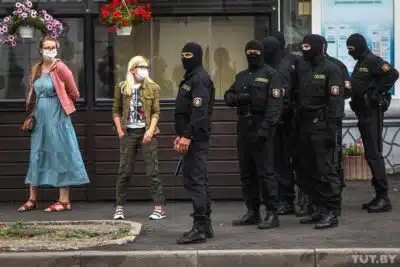
Belarus exemplifies how digital control complements physical repression.
After 2020, authorities expanded online surveillance, prosecuted social media activity, and criminalized information sharing.
Telegram channels were labeled extremist, VPN usage scrutinized, and users arrested based on digital evidence.
The Psychological Dimension of Digital Control
Beyond arrests and censorship, digital repression reshapes behavior.
Self-censorship becomes normalized. Users avoid sharing, liking, or even reading content perceived as risky.
This chilling effect is one of the most effective tools in the authoritarian digital arsenal.
Trust, Expertise, and Digital Literacy
Surviving digital authoritarianism requires reliable information.
Disinformation thrives in repressive environments, often spread deliberately to compromise security.
Trusted organizations, cybersecurity experts, and independent journalists play a crucial role in educating users and debunking myths.
Adaptation and the Future of Digital Resistance
Authoritarian digital systems evolve constantly. So do resistance strategies.
Decentralized platforms, peer-to-peer networks, and encrypted storage are increasingly explored.
Yet technology alone cannot guarantee safety. Collective awareness, solidarity, and education remain essential.
Why This Struggle Matters Globally
The techniques tested in authoritarian states rarely remain confined there.
Surveillance technologies, data collection practices, and censorship models often spread internationally.
Understanding survival strategies in an authoritarian digital environment is therefore relevant far beyond Belarus.

Survival Is Not Silence
Telegram, VPNs, and anonymity are not tools of rebellion by default. They are tools of survival.
In an authoritarian digital ecosystem, staying informed, connected, and protected is itself an act of resistance.
While states seek total visibility, citizens continue to carve out spaces of autonomy—quietly, cautiously, and persistently.
The future of freedom may depend not only on streets and ballots, but on the ability to remain human in a monitored digital world.


 English