
Belarus’s “Social Parasite” Tax: What Decree No. 3 Was and Why People Protested It
Table
Belarus’s “social parasite tax” was a fee created by Presidential Decree No. 3 of 2 April 2015, “On preventing social dependency”. It charged working-age citizens who worked under half a year and did not register with the labour bureaus. Mass protests in February–March 2017 followed, and the decree was repealed in 2018.
What was Decree No. 3 of 2015?
Decree No. 3 is a presidential decree that obliged able-bodied Belarusians without registered work to pay an annual sum to the state. Its official title is “On preventing social dependency”, and the Belarusian presidential website dates it to 2 April 2015. RFE/RL notes that the government itself calls it the “Law Against Social Parasites”.
The nickname came from the public. At a government conference on 6 December 2016, Alexander Lukashenko said Belarusians called the measure a “decree against freeloaders”. He added that he was “most of all concerned” about how people who could work but did not were viewed, and that such a person should earn a living.
Who had to pay, and how much?
The fee applied to working-age Belarusians who worked fewer than 183 days in a calendar year, a threshold reported by The Guardian, and who were not registered with the labour bureaus. The table summarizes the main terms.
| Term | Detail | Source |
|---|---|---|
| Legal basis | Decree No. 3, 2 April 2015 | Presidential website |
| Who paid | Citizens who worked less than half of a calendar year and did not register with the labour bureaus | RFE/RL |
| Amount | More than US$200 | RFE/RL |
| Notices sent in error | University students, women on maternity leave and active-service soldiers, as Lukashenko was told in December 2016 | Presidential website |
| Exemptions (announced Dec 2016) | Unarmed-service military personnel; athletes on national teams with no income; people in difficult life situations, decided by municipal bodies | Presidential website |
| Deadlines (announced Dec 2016) | Notices on 20 January 2017, payment by 20 February 2017, to allow the payer database to be updated | Presidential website |
| Scale | About 470,000 people liable; roughly 10% had paid by mid-February 2017 | Reuters |
The last row explains much of what followed. If only about one in ten of those billed had paid nearly two years after the decree, the measure was closer to a mass refusal than to a functioning tax.
Why did it trigger the 2017 protests?
The tax drew protests because it billed people for not holding a formal job, whatever the reason. Students and mothers on leave had received notices, as the presidential report on the December 2016 conference shows. The question of unregistered work and undeclared income runs through Belarus’s informal economy, where a person without a formal contract is not necessarily a person without work.
What happened during the Belarus parasite tax protests of 2017?
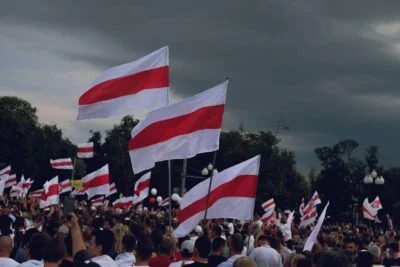
The Belarus parasite tax protests of 2017 began in Minsk on 17 February and spread to regional cities within days. Key dates:
- 17 February 2017: Reuters reported a protest of about 2,500 people in Minsk.
- 19 February 2017: Reuters reported about 2,000 people in Gomel (Homel).
- 26 February 2017: RFE/RL reported rallies in Vitsebsk, Babruysk, Berastse and Baranavichy. In Vitsebsk more than 1,000 people marched through the city and rallied on Freedom Square.
- 15 March 2017: a march in Minsk, the “March of the Social Parasites”, was covered by The Guardian.
RFE/RL described the Vitsebsk rally as a rare sign of political dissent in a tightly controlled country. Rallies in four regional cities on a single day set 26 February apart from the Minsk march nine days earlier.
Crowd counts differ by source, and the figures above are those each named outlet reported. The rallies belong to a longer line of protest and resistance movements that continued after the 2020 election. Rising living costs, discussed in how prices erode household incomes, remain part of the backdrop to any tax dispute in the country.
How did the government respond?
The government defended the decree but announced changes to it before the 2017 rallies. According to the presidential website’s report on the 6 December 2016 conference, Lukashenko said: “We are not going to argue with the people.” Deputy Prime Minister Natalya Kochanova told the meeting that monitoring by the government and the Presidential Administration had found the decree “topical, necessary, and objective”, with a positive effect on employment.
Lukashenko said he had received proposals to scrap the decree altogether, citing heavy criticism and administrative difficulty, and rejected them. The decree would remain in force with its shortcomings fixed by amendments. The report lists these changes:
- municipal councils and executive bodies would decide whether people in unforeseen life situations were exempt;
- the exempt categories would grow to include unarmed-service military personnel and athletes on national teams with no income;
- tax would be calculated against the full income tax a person had paid, so that deductions such as state subsidies for housing or education did not distort the result.
Payment dates moved to 20 January and 20 February 2017. The first Minsk protest, on 17 February, came three days before the payment deadline. The episode is one of many in Lukashenko’s three decades in power, and in the country’s later economic downturn the question of who counts as “working” has not gone away.
Is the parasite tax still in force?
No. Decree No. 3 was repealed in 2018, so the fee is no longer charged. The 2015 decree remains the reference point for the 2017 rallies, which grew out of the payment deadlines that the December 2016 amendments had set.
Frequently asked questions
A fee of more than US$200 charged to working-age citizens who worked less than half of the year and did not register with the labour bureaus, created by Decree No. 3 of 2015.
Who was exempt?
In December 2016 the government announced exemptions for unarmed-service military personnel and athletes on national teams without income, plus people in difficult life situations whom municipal bodies could exempt.
How many people were liable?
Reuters reported in February 2017 that about 470,000 people were liable and that roughly 10% had paid.
Why did Belarusians protest it?
The tax billed people for not holding a formal job, and notices had reached students, mothers on maternity leave and soldiers. Rallies took place in Minsk, Vitsebsk and other cities in February and March 2017.
Was the parasite tax abolished?
Yes. Decree No. 3 was repealed in 2018, after the protests of February–March 2017.
Is the parasite tax still in force today?
No. The fee is no longer charged.
What changes did the government announce?
In December 2016 it said it would keep the decree but amend it: payment dates would move to 20 January and 20 February 2017 and exemptions would be added.
Sources
- Presidential administration of Belarus, report on the government conference on preventing social dependency, 6 December 2016.
- RFE/RL, report on the 26 February 2017 protests in Vitsebsk and other cities.
- Reuters, 17 February 2017, report on the Minsk protest; Reuters, 19 February 2017, report on Gomel.
- The Guardian, 17 March 2017, “We are not slaves”.
Belarusian Resistance Movements of the 20th Century

Yekaterina Vasilyeva: 5 Brilliant Roles to Watch

Sergey Bezrukov’s Top 5 Roles That Shaped Cinema
 English
Leave a Reply
You must be logged in to post a comment.