
Belarus 2017 Protests and Political Prisoners: What the March Crackdown Revealed

5 min read
In this article
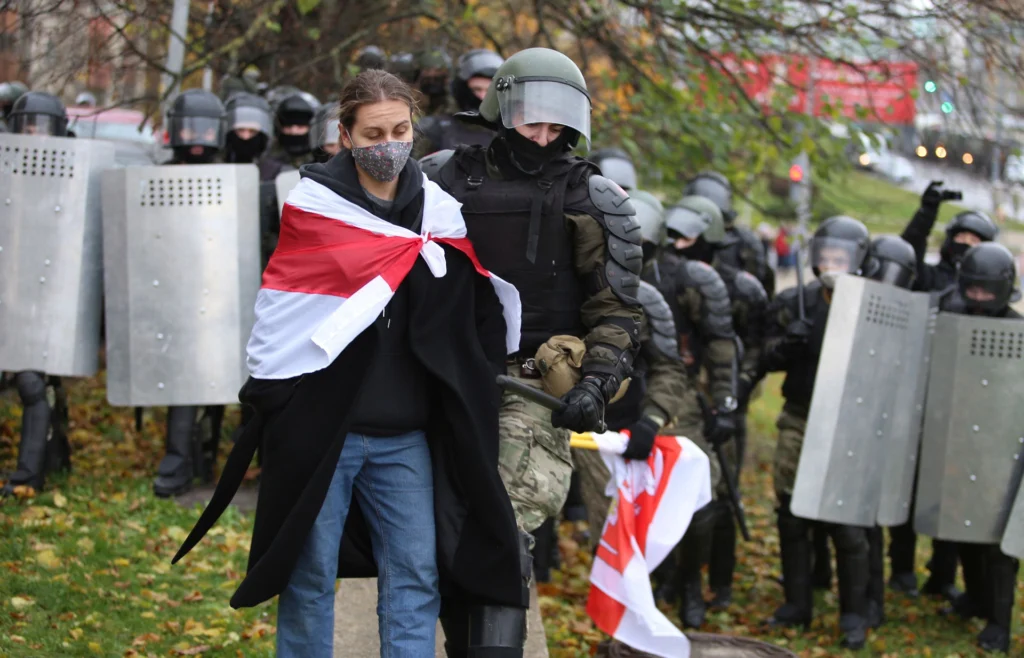
In March 2017, Belarusian authorities detained at least 700 people during protests against the so-called social parasite tax, according to Human Rights Watch. Amnesty International recorded at least 48 detained on 10–12 March; FIDH counted at least 70 on 15 March and 54 sentenced the following day, mostly to short administrative detention.
The episode showed how a tax dispute could be turned into a mass policing operation. It also left two separate paper trails: day-by-day detention counts kept by rights groups, and a narrower list of political prisoners tracked by Viasna. The rest of this article separates those records and traces the 2017 events forward.
What happened in March 2017
Protests against the social parasite tax began in February 2017 and spread through Minsk and regional cities such as Brest, Hrodna (Grodno) and Vitsebsk. The police response was not one operation but a rolling series of detentions tied to specific days of action. Freedom Day, 25 March, was one of the flashpoints. Human Rights Watch’s report title referred to the date, reflecting the way the late-March detentions were treated as part of a single wave. The figures below are the minimum counts that each organisation said it could confirm.
| Date | Event | Figure | Source |
| 10–12 March 2017 | Detentions during early March street protests | at least 48 detained | Amnesty International |
| 15 March 2017 | Detentions in Minsk and regional cities | at least 70 detained | FIDH |
| 16 March 2017 | Court sentences after the 15 March detentions | 54 sentenced to up to 15 days | FIDH |
| March 2017 total | Protest-related detentions across the month | at least 700 detained | Human Rights Watch |
These figures should be read as floors, not complete totals. FIDH’s two-week count rose above 200 arrests or detentions. No single organisation claimed to have a complete daily record; each figure is the minimum it could verify through its own monitors and court observers. Some people were held briefly and released without appearing in court; others were taken before a judge within a day or two. The 16 March sentences, mostly to up to 15 days of administrative detention, show how quickly street arrests were converted into punishment. The use of administrative detention rather than criminal charges also meant that most cases were closed quickly, which is why rights groups relied on courtroom monitoring and witness accounts.
Why it mattered: political prisoners and short-term detention
Most of the March 2017 detentions were administrative rather than criminal. A person held during a protest could be sentenced to a fine or up to 15 days and then released, with no long-term political prisoner status. Viasna, the Belarusian human rights group, tracks political prisoners as a separate category; its count is not simply the sum of everyone detained that month.
Amnesty International said that those detained included civil society leaders and independent journalists, not only rank-and-file demonstrators. That raised the political stakes. The presence of journalists and organisers indicated that the authorities were not only responding to an unauthorised gathering but also disrupting people who could document and publicise the crackdown.
The term political prisoner, as used by Viasna, applies to people held on criminal charges because of their political activity. It does not automatically include everyone given a short administrative sentence. That is why the March 2017 totals and the political prisoner lists need to be read separately. The 2017 wave produced many short punishments; it did not by itself fill the long-term political prisoner lists that Viasna would compile after 2020.
Reactions from human rights bodies
Human Rights Watch titled its statement on 3 April 2017 “Belarus: Freedom Day Crackdown”. It took the protests around Freedom Day as a lens for a wider pattern. Amnesty International described the events as the “biggest crackdown in years”, with dozens detained at a single protest.
The UN human rights office, OHCHR, said in a statement on 14 November 2017 that the authorities used arbitrary detention and pursued political opponents. OHCHR’s statement placed the November arrests in the same trend as the March detentions, connecting both to the persecution of political opponents. Its language also pointed to a continuing method of control: arrests at protests, brief trials and administrative penalties.
FIDH recorded more than 200 arrests or detentions across two weeks. The gap between the two-week figure and the month-long total reflects the fact that rights groups used different periods and minimum thresholds.
Together, the statements shifted the international debate from the tax itself to the treatment of dissent. They did not rely on identical numbers, but they pointed in the same direction: mass detention was real, and it was aimed at public assembly.
Legal and political context
The trigger was Presidential Decree No. 3 of 2 April 2015. Under the decree, adults deemed not to be in work for part of the year could be required to pay an annual fee. The measure became known as the “social parasite tax”. The accompanying page on Decree No. 3 and the 2017 protests explains the rules and exemptions.
Protests against the fee began in February 2017, and by March they had become openly political. Demonstrators connected the fee to a wider absence of legal channels for public disagreement. The authorities treated the gatherings as administrative offences and made detention the standard response.
Short-term administrative detention was already familiar. A person could be detained for participating in an unauthorised event, taken to court within days, and sentenced to a fine or up to 15 days. The system allowed the authorities to break up a protest without bringing heavier criminal charges that would have attracted more scrutiny.
From 2017 to today: where the cases stand
The social parasite fee was suspended after the protests, but the legal and administrative machinery that handled the protests remained intact. The larger 2020 protest wave brought far higher detention numbers and longer sentences. It also pushed Viasna’s political prisoner count sharply upward. By 2025, human rights organisations were still documenting arrests, trials and prison conditions from the 2020 cycle and after. The 2020 timeline on this site records the larger crackdown; the prison and human rights defender pages show how the categories of detention and monitoring have evolved since 2017.
Belarus’s prison system remains central to how the state manages dissent. Cases from both 2017 and the post-2020 period follow a similar rhythm: rapid detention, brief court appearances, and then longer pressure on those considered most active.
Human rights defenders in Belarus have continued to document these cases, even as many operate from exile. Their monitoring extends the work that was visible in the March 2017 street counts.
Lukashenko’s three decades in power provide the longer arc. The 2017 crackdown was not a one-off; it was a bridge between the smaller protest cycles of the 2010s and the much larger 2020 repression.
For the people detained in March 2017, the immediate cases were short, but the episode entered the human rights record as an early warning. Viasna’s political prisoner lists grew most sharply after 2020, not in 2017, but the March detentions foreshadowed how quickly the state could move.
FAQ
How many people were detained during the March 2017 Belarus protests?
Human Rights Watch recorded at least 700 people detained across March 2017; FIDH reported at least 70 on 15 March and 54 sentenced to up to 15 days the next day.
What was Belarus’s social parasite tax?
Presidential Decree No. 3 of 2 April 2015 imposed an annual fee on adults deemed not to be in work for part of the year, and it triggered the February–March 2017 protests.
Did the 2017 crackdown create long-term political prisoners?
It mainly produced mass short-term administrative detentions; longer-term political prisoner cases are tracked separately by Viasna and grew sharply after 2020.
 English
Keep reading