
Erased Murals, Persistent Memory

Table
Erased Murals, Persistent Memory is more than a metaphor. It describes a recurring reality in Belarus and across Eastern Europe, where murals briefly emerge as acts of public resistance only to be swiftly removed by authorities. These erased murals, however, do not disappear from collective consciousness. Instead, they continue to exist through memory, documentation, and shared experience.
Murals occupy a fragile but powerful space. Painted directly onto public walls, they bypass traditional media channels and speak directly to citizens. When states erase them, they unintentionally confirm the murals’ significance. This article examines why erased murals matter, how memory survives repression, and why visual resistance continues to challenge authoritarian narratives.
The Political Power of Murals
Murals differ from other art forms in one critical way: they are unavoidable. Anyone passing by becomes an audience member. This directness gives murals political power, especially in environments where media is controlled and dissent is criminalized.
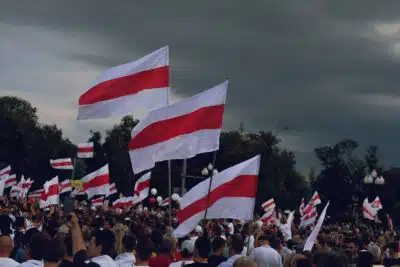
In Belarus, murals that appeared after the 2020 protests depicted detained activists, historic symbols, and demands for accountability. Their presence transformed ordinary streets into sites of dialogue and resistance.
Visibility as a Threat
Authoritarian regimes rely on narrative control. Murals undermine this control by introducing alternative truths into shared spaces. Unlike online content, murals cannot be quietly censored. Their removal requires visible intervention, making repression public.
The state’s fear of murals lies not in their artistic value, but in their capacity to normalize dissent. A single image, seen daily by thousands, can quietly reshape public perception.

Erased Murals as Living Memory
When a mural is erased, its physical form disappears, but its meaning often intensifies. Residents remember what once occupied the wall. Conversations reference the image. Photographs circulate online.
This transformation reflects the concept of memory as a social process. Erased murals become symbolic landmarks, remembered precisely because they were forbidden.
Erased Murals, Persistent Memory captures this dynamic: repression does not eliminate meaning—it relocates it.
Digital Preservation
Smartphones and independent media have fundamentally changed how murals survive erasure. Images are archived, shared, and contextualized within hours.
Cultural organizations emphasize the importance of digital documentation in preserving endangered expressions of art and identity. The International Council of Museums highlights digital preservation as a key tool in protecting cultural memory.
Belarus and Systematic Artistic Erasure
Belarus stands as a contemporary example of how states treat public art as a security threat. After the disputed 2020 election, murals appeared across Minsk and other cities, often overnight.
Municipal workers, frequently accompanied by police, removed these artworks with remarkable speed. Walls were repainted, surfaces cleaned, and traces eliminated.
The Message Behind the Removal
The efficiency of mural erasure revealed the regime’s priorities. These were not acts of vandalism, but expressions of public sentiment. By erasing them, authorities acknowledged their power.
Human rights organizations have documented cultural repression as part of broader political control. According to Human Rights Watch, restrictions on artistic expression in Belarus are integral to silencing dissent.
Historical Patterns of Erased Murals
The destruction of political murals has deep roots in Eastern Europe. During the Soviet era, unofficial wall art criticizing the state was routinely removed.
In Poland during the 1980s, Solidarity-era murals reappeared repeatedly despite constant erasure. Each act of removal reinforced their symbolic power.
From the Berlin Wall to Modern Streets
The Berlin Wall remains a powerful historical parallel. While the eastern side was kept blank through constant repainting, the western side became a canvas of memory and protest.
Today, erased murals in Belarus follow a similar pattern: temporary presence, permanent legacy.
The Psychology of Remembering Erased Art
Visual images are processed faster and retained longer than text. When tied to emotional experiences—fear, hope, solidarity—they become deeply embedded in memory.
The act of erasure intensifies this effect. What is forbidden often becomes more memorable. Erased murals transform into shared symbols of resistance.
Silent Resistance Through Absence
As repression intensifies, some artists adopt subtler approaches. Instead of explicit messages, they use abstraction, absence, and symbolism.
Blank walls, faint outlines, or carefully chosen colors communicate dissent without providing authorities clear justification for removal. Viewers who understand the context recognize the message immediately.
This evolution demonstrates how artistic resistance adapts to survive.
Trust, Documentation
Preserving erased murals requires accuracy and ethical responsibility. Misrepresentation weakens credibility and undermines trust.
Journalists, historians, and cultural researchers ensure that documentation remains verifiable and contextualized. Organizations such as PEN International stress that protecting artistic expression is essential to safeguarding democratic memory.
Why Erased Murals Still Matter
Erased murals matter because they reveal the fragility of authoritarian control. A regime can repaint walls, but it cannot erase collective memory.
Each erased mural leaves behind unanswered questions that sustain public discourse. These questions are themselves acts of resistance.
Erased Murals, Persistent Memory ultimately reflects a broader truth: memory outlives repression.

Memory as Defiance
In Belarus and beyond, erased murals continue to shape identity, history, and resistance. They survive in images, archives, conversations, and imagination.
Authoritarian power depends on enforced forgetting. Art depends on remembrance. As long as memory persists, erasure will remain incomplete.
The walls may be repainted, but history remembers what they once revealed.
Festivals Without Freedom: Entertainment as Propaganda
Filmmakers in Exile: Creating Without a Homeland

How Art Preserves Memory When History Is Rewritten
Belarus Resistance Art - How Artists Resist: Music, Graffiti and Subversion

Media Freedom in Belarus 2025: Independent Journalism Under Siege

Alexander Masliakov: The Legacy of a Russian TV Icon
 English