
Belarus 2020 Protests Timeline: From the August Election to the Crackdown
Table
The 2020 Belarus protests began on 9 August 2020 after official results gave Alexander Lukashenko a sixth term. Hundreds of thousands marched for weeks; over 30,000 people were detained and at least four protesters died. The movement declined in autumn 2020 and its networks fed the repression of 2021–2025. This chronology moves from the campaign and the ballot through the largest street demonstrations in modern Belarus, and then to the slower crackdown that followed.
Timeline at a Glance
The core dates are drawn from the Central Election Commission’s official returns and from documentation by OHCHR, Human Rights Watch and Amnesty International.
| Date | Event | Key figures | Source |
|---|---|---|---|
| 18 June 2020 | Viktar Babaryka detained during the campaign | One main challenger removed | Human Rights Watch |
| 9 August 2020 | Presidential election held; Central Election Commission announces preliminary returns | Lukashenko about 80.1 %, Tsikhanouskaya about 10.1 % | Central Election Commission |
| 9–11 August 2020 | First crackdown: night-time clashes, mass detentions, use of force | Two protester deaths documented in the first days | OHCHR, Human Rights Watch, Amnesty International |
| 11 August 2020 | Tsikhanouskaya leaves for Lithuania under pressure | One candidate leaves; opposition continues | Human Rights Watch |
| 12–13 August 2020 | Women-led marches in white and red in Minsk and other cities | Tens of thousands | OHCHR |
| 16 August 2020 | Largest single protest of the cycle in central Minsk | Hundreds of thousands | Amnesty International |
| 23–27 August 2020 | Renewed Sunday marches and continuing arrests | Tens of thousands detained over the period | Human Rights Watch |
| Autumn 2020 | Mass marching fades; trials, arrests and media closures continue | Political prisoners counted continuously | Viasna |
This is a condensed version of a contested nine months. Official figures put Lukashenko above 80 per cent; independent estimates and opposition observers rejected the count.
Before the Election: May–August 2020
The 2020 Belarusian protests drew on patterns that earlier Belarusian resistance movements of the 20th century had already tested. The campaign that produced them narrowed quickly, often through arrests rather than votes.
- May 2020: Sergei Tikhanovsky was taken into custody after declaring a presidential bid. His wife, Sviatlana Tsikhanouskaya, later entered the race with the support of the detained campaign team.
- 18 June 2020: Viktar Babaryka, a former bank executive who was registering as a candidate, was detained; human rights groups described the case as politically motivated.
- July 2020: The remaining campaign consolidated around Sviatlana Tsikhanouskaya, Maria Kalesnikava and Veranika Tsapkala, who called for fair elections and the release of political detainees.
- 29 July 2020: The Wagnergate episode interrupted the race when the authorities announced the detention of 33 men they linked to Russian private military contracting.
By early August the field had been reduced to one credible challenger, and the opposition had moved from signature collection and petition drives to street mobilisation. The detentions did not reduce participation; instead they concentrated energy behind a single campaign.
Election Day and the First Crackdown: 9–11 August
The Belarus election protests 2020 began on the night of the ballot, not after a long pause. The Central Election Commission reported about 80.1 per cent for Lukashenko and about 10.1 per cent for Tsikhanouskaya. Opposition candidates and independent observers rejected those figures as fraudulent. Riot police and OMON/AMAP cleared the first gatherings with batons, stun grenades and mass arrests. Human rights groups documented the deaths of Alexander Taraikovsky and Hienadz Shutau in the first days of the crackdown, and by the end of the initial phase they had recorded at least four protester deaths. Thousands of people were held in temporary detention facilities; many described being held without access to lawyers or family. That pattern, documented by OHCHR and later by Human Rights Watch, set the template for the months that followed.
The Mass Protests: August–September
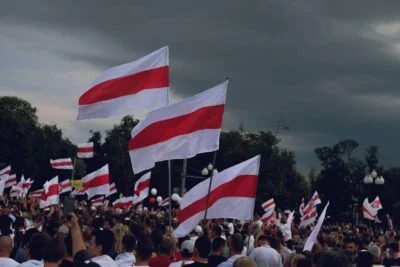
August and September were the high point of the 2020 Belarusian protests. Women-led marches on 12–13 August brought a different visual register: long lines of women in white carrying flowers, avoiding frontal confrontation with riot police. On 16 August, hundreds of thousands of people gathered in central Minsk in what human rights groups described as the largest demonstration in Belarus’s post-Soviet history. Marches on 23 August and 27 August continued the rhythm of Sunday mobilisation, while arrests and detentions continued through the week. Nexta, a Telegram channel, circulated locations and times, which helped crowds form quickly despite internet disruptions. The white-red-white flag became a common sight at these gatherings, and protesters from different generations joined the marches. The Coordination Council, created in August with Tsikhanouskaya as a leading figure, attempted to negotiate a transfer of power; within weeks its key members were arrested or forced into exile. Human rights groups later documented more than 35,000 detentions across the whole campaign. The size of the crowds changed the political calculation abroad: European foreign ministers condemned the crackdown and began listing Belarusian officials for travel bans and asset freezes. Factory workers at several large plants called short strikes in August, although state managers threatened dismissal and the strikes did not widen into a general stoppage. Unlike the brief local actions of earlier years, the August crowds were broad enough to bring together young people, families and older residents.
Why the Protests Declined: Autumn 2020–2021
Mass participation fell in autumn 2020 because the authorities combined street repression with criminal prosecutions and economic pressure. Courts handed down heavy sentences for small acts of protest; independent media were closed or designated extremist; and strike calls were answered with dismissals and threats. The government used the same authoritarian control tactics that had kept it in power since the 1990s, and many of those detained entered the machinery of political imprisonment. Viasna kept a continuous count of political prisoners as arrests moved from street corners to workplaces and courtrooms. By the end of 2020 the visible marches had faded, but the repression that followed acquired its own institutional rhythm. Some organisers left the country; others remained underground; both groups became foundations of the later exile and resistance networks.
Aftermath: How 2020 Shaped 2021–2025
The protest wave did not remove the government, but it reshaped what followed. The European Union, the United States and the United Kingdom imposed sanctions on officials and state enterprises; Russia’s full-scale invasion of Ukraine in 2022 deepened Minsk’s dependence on Moscow. The full sequence is set out in the political repression timeline (2020–2025). The consequences are visible in the human rights crisis in 2025. Part of the opposition moved abroad, building the Belarusian diaspora in 2025. Inside Belarus, political prisoners became a permanent category rather than an episode. The experience of 2020 became the reference point for solidarity campaigns and for the legal cases pursued abroad.
Glossary: People, Groups and Acronyms
- Alexander Lukashenko: incumbent president in power since 1994.
- Sviatlana Tsikhanouskaya: opposition candidate in 2020 and later leader in exile.
- Central Election Commission (CEC): state body that published the official result.
- OMON/AMAP: riot police units used in dispersals.
- Coordination Council: opposition body created in August 2020 to negotiate a transition.
- Nexta: Telegram channel that relayed protest locations and footage.
- Viasna: Belarusian human rights organisation that counts political prisoners.
- White-red-white flag: historic flag used by the protesters.
FAQ
What happened on 9 August 2020 in Belarus?
Official results gave Lukashenko about 80 %; the opposition and observers rejected them as fraudulent, and the first crackdown began that night.
How many people were detained during the 2020 Belarus protests?
More than 30,000; human rights groups documented over 35,000 detentions across the campaign.
When did the 2020 Belarus protests end?
Mass marching faded in autumn 2020, but arrests, trials and exile continued through 2021 and beyond.
Who led the opposition in the 2020 Belarus protests?
Sviatlana Tsikhanouskaya, with Maria Kalesnikava and Veranika Tsapkala after key candidates were jailed or forced out.
Did the protests change anything?
They did not remove Lukashenko; they hardened repression, expanded exile and shaped the resistance and sanctions that followed.
Sources
- Office of the United Nations High Commissioner for Human Rights (OHCHR) — reports on detentions, use of force and deaths.
- Human Rights Watch — reports on detentions, deaths and trials.
- Amnesty International — reports on arbitrary detention, torture and the security response.
- Central Election Commission of Belarus — official returns for the 9 August 2020 election.
- Viasna — continuous count of political prisoners.


 English