

Belarus Public Opinion Surveys: What the Data Shows
6 min read
Table
Belarus has no reliable independent opinion polling after 2020: the main post-2020 effort is the Belarus Initiative's online panel with Chatham House. Its August–November 2025 waves suggest broad opposition to the war and deep economic pessimism, but samples skew urban and educated, so figures are directional rather than nationally representative.
Why Belarusian Public Opinion Surveys Moved Online
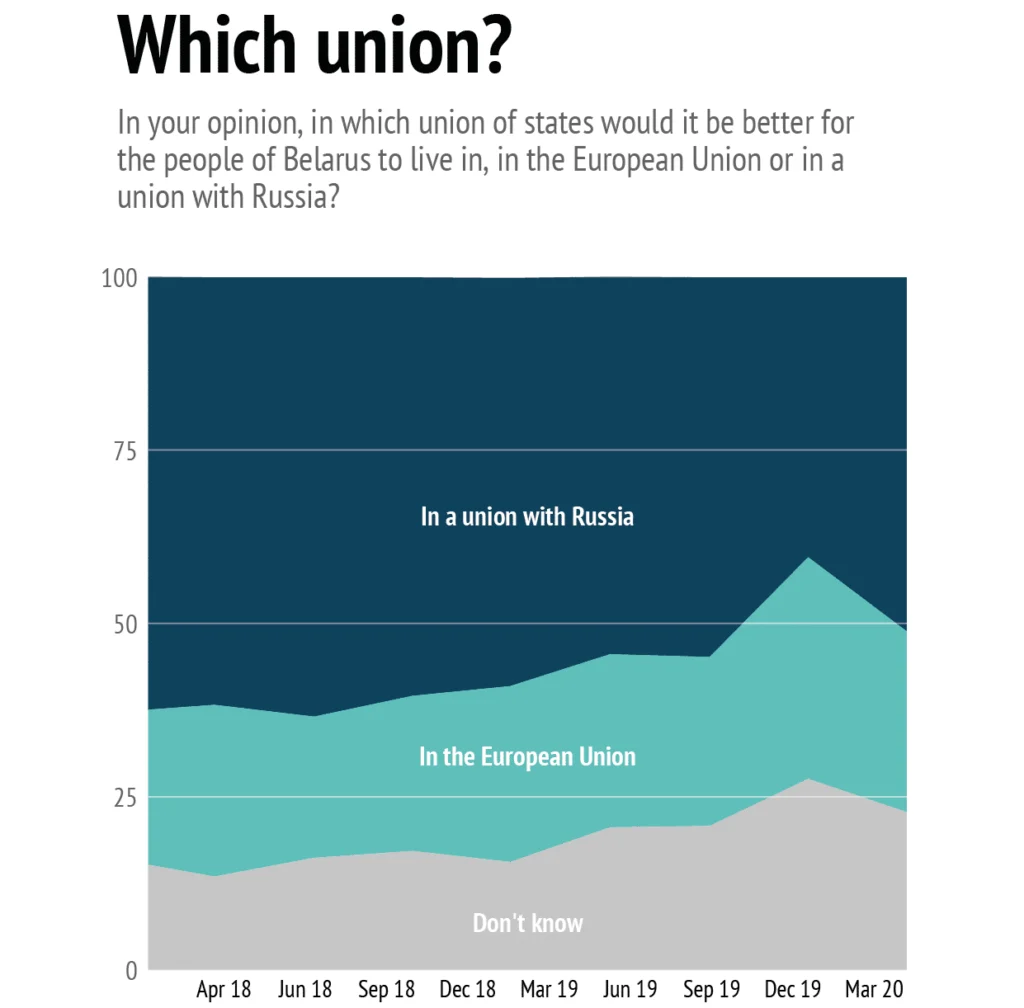
Belarus has not had a nationally representative independent face-to-face poll since the 2020 protests. The reference institute of the 1990s and 2000s, IISEPS, lost its state registration in 2005–2006, a rupture that forced much of its work abroad. After the August 2020 presidential election, the authorities prosecuted and dispersed part of the remaining survey field, and projects that continued did so from exile. The main post-2020 exception is the Belarus Initiative, an independent research programme run with Chatham House. Their main tool became CAWI, computer-assisted web interviewing, in which respondents complete a questionnaire online rather than in a face-to-face interview. An online panel is a pre-recruited group of people willing to answer repeated surveys, usually recruited through social media and diaspora networks. That method is cheaper and safer, but it skews towards urban, educated and digitally connected respondents. Years of economic contention, from the 2015 ‘social parasite’ tax to the 2020 protests, had already reduced trust in official numbers. The independent field adapted by moving online, a process that drew on the infrastructure of Belarusian resistance movements and exile networks. Historical IISEPS Belarus polls still circulate in academic work, but they refer to a different sampling frame. The pre-2020 baseline often cited in academic work comes from the World Values Survey and European Values Study. Newer Belarus public opinion surveys should therefore be read as directional signals, not as exact national percentages.
Who Still Surveys Belarusians: A Comparison Table
Five sources are most often cited when international reporting needs a Belarusian figure. The table compares the dates, samples, methods, main findings and data access that are documentable in the latest release cycle. For Chatham House Belarus survey releases, the methodology note matters as much as the headline number.
| Source | Year | Sample | Method | Main finding | Microdata |
|---|---|---|---|---|---|
| Belarus Initiative / BelarusPoll | 2025, August–November waves | under 1,000 per wave, online panel | CAWI | broad opposition to the war; deep economic pessimism; directional only | XLSX/SAV at belaruspolls.org |
| Chatham House | 2025 | not stated in release summaries | secondary analysis and release partner | provides methodological framing and public releases with the Belarus Initiative | releases hosted by Chatham House |
| BISR | recent published data | not stated | not stated | rural quality of goods and services | not stated |
| OSW | 2021 | not stated | survey of attitudes to Poland, Russia and the Polish Card | 62.1 per cent positive attitude towards the Polish Card | not stated |
| World Values Survey / European Values Study | earlier waves | nationally representative in earlier designs | face-to-face | historical baseline for values and trust | available through each project |
The OSW figure of 62.1 per cent is the most concrete comparative datapoint in the table; it comes from a 2021 survey of Polish, Russian and Polish Card attitudes. Most newer Belarus Initiative polls report direction rather than precise national shares. Independent pollsters do not always disclose funders in the same place; users should record what is available rather than infer missing rows.
What the Latest 2025 Waves Show
The most citable post-2020 dataset is the wave file published by belaruspolls.org and attributed to the Belarus Initiative, with Chatham House as research partner. The August–November 2025 waves are small: fewer than 1,000 respondents per wave and a margin of error around three percentage points. Their consistent signals are broad opposition to the war, scepticism about foreign-policy alignment and deep economic pessimism, a mood that matches the silent inflation and stagnant wages documented elsewhere. Because the same direction appears across waves, researchers treat the data as a reliable indication even though exact shares cannot be projected onto the whole population. Official figures published by the authorities are not comparable; they come from a different, less transparent methodology and should be labelled separately. Independent estimates range more widely because panel recruitment and weighting assumptions differ by project. A responsible citation therefore reads ‘online panel data, directionally indicative’, not ‘a national poll’. The Belarus Initiative polls are best used for questions about war, economy and foreign policy rather than for demographic subgroup breakdowns. Researchers who report these figures should also record the wave number, because question wording changes between waves.
How to Read a Belarusian Poll: Five Checks
A figure from Belarus should not enter a story without five checks. They apply to Belarus Initiative polls, Chatham House Belarus survey releases, historical IISEPS Belarus polls and any other dataset.
- Name the pollster and funder. Independent projects often have academic, philanthropic or diaspora backing; state-run polls serve official communication. Put the funder in the caption or source note, not just in a link.
- Confirm the date and mode. Check fieldwork dates and whether the mode was CAWI, telephone or face-to-face. After 2020 most independent work is CAWI, which reaches internet users but misses people with limited connectivity.
- Read the original question in Russian or Belarusian. English paraphrases can shift a result by several points, especially on sovereignty, war and national identity, where language carries the weight of state-building myths and memory. Ask for the exact wording before quoting.
- Check sample size and composition. A sample of fewer than 1,000 people can support exploratory findings with a disclosed margin of error around three percentage points, but an 80 per cent urban sample cannot stand in for the whole country. Sampling bias is the gap between the people reached and the population the poll claims to describe.
- Do not treat it as a forecast. An online panel is a snapshot of a reachable population, not a prediction of elections or policy outcomes. Use it for direction, not for exact seat counts or turnout.
Together, these checks allow a reader to separate a stable signal from a fragile number.
What Surveys Cannot Tell Us
Even the best Belarusian public opinion survey has hard limits. Fear of being identified suppresses answers on security services, protest participation and any question that names senior officials, including President Lukashenko. No independent project has run a national face-to-face sample since the post-2020 crackdown, so rural, older and offline citizens are systematically underrepresented. The census and administrative data are not current enough to reweight an online panel with confidence, and many respondents reach such surveys through the same digital survival under surveillance practices that shape everyday internet use. When citing, put the limitation in one clause: ‘online panel, urban-skewed, not nationally representative’. That is not a criticism of the pollster; it is the correct description of what current methods can measure. Historical IISEPS data and older World Values Survey or European Values Study waves remain useful for baseline comparison, but they are not substitutes for current estimates. Researchers should not fill the gap with official numbers presented as independent confirmation.
Sources and Microdata
Primary data should begin with the Belarus Initiative’s repository on belaruspolls.org, where wave files are published as XLSX and SAV. Chatham House hosts the release notes and analytical summaries that accompany the Belarus Initiative waves. The OSW 2021 study is available from the Centre for Eastern Studies, and the World Values Survey and European Values Study distribute their microdata through their own archives. Before quoting a figure, record the wave number, fieldwork dates and file version. If a chart shows only a percentage without those details, request the original questionnaire and the weighting script. Access to microdata matters because it allows the reader to test how a figure was produced rather than relying on a headline.
Frequently Asked Questions
How reliable are Belarus public opinion surveys? Directionally useful but not nationally representative; samples skew urban and educated, and respondents fear being identified.
What is the Belarus Initiative and what does its polling show? An independent research effort using online panels; 2025 waves show majority opposition to the war and economic pessimism.
Why did independent face-to-face polling stop in Belarus? IISEPS lost its licence in 2005–2006; post-2020 repression pushed projects online and into exile.
Can a sample of fewer than 1,000 people be enough? Yes for exploratory and directional findings with a disclosed margin of error around 3 per cent, but not for nationwide demographic breakdowns.
Where can I download raw survey data? belaruspolls.org publishes XLSX and SAV microdata; Chatham House hosts Belarus Initiative releases.
Silent Inflation and Stagnant Wages
How Activists Protect Themselves Online
Brain Drain and Economic Collapse: Who Is Leaving Belarus?
Belarusians in the War in Ukraine: Stories, Symbols, and Memory

Climate Change, Agriculture, and Small Cities in Belarus: Challenge and Opportunity
Belarus State Media: How The Propaganda Machine: Shapes Public Opinion in 2025
 English